
Salesforce reported earnings on Wednesday, and while it wasn’t quite the heady rush of last quarter’s unexpectedly strong offering, it was by all accounts decent. And as far as Wall Street is concerned, the numbers beat analyst’s expectations. Good on them, that always feels like a key investor metric when judging the quality of a quarter.
When you consider the stakes of the prior quarter, when activist investors were circling, the company did well enough to ease the pressure. Now it has to do everything else.
The company’s $8 billion in revenue certainly wasn’t anything to sneeze at. Salesforce grew 11%, down slightly from last quarter’s 14%. Overall, though, the numbers, if anything, look a little mixed with some good news and some not so good: Some parts of the business were growing quite slowly, and perhaps worse, continuing to decelerate.
That said, however, perhaps one of the most interesting pieces of data in the financial report was which part of the company’s core offerings was actually the fastest growing cloud. Probably not the one you think. In fact, it was the newest one: Data Cloud, which launched last year at Dreamforce. (They called it Genie then, but as the company often does when it comes to product names, it changed the name a few months later to Data Cloud.)
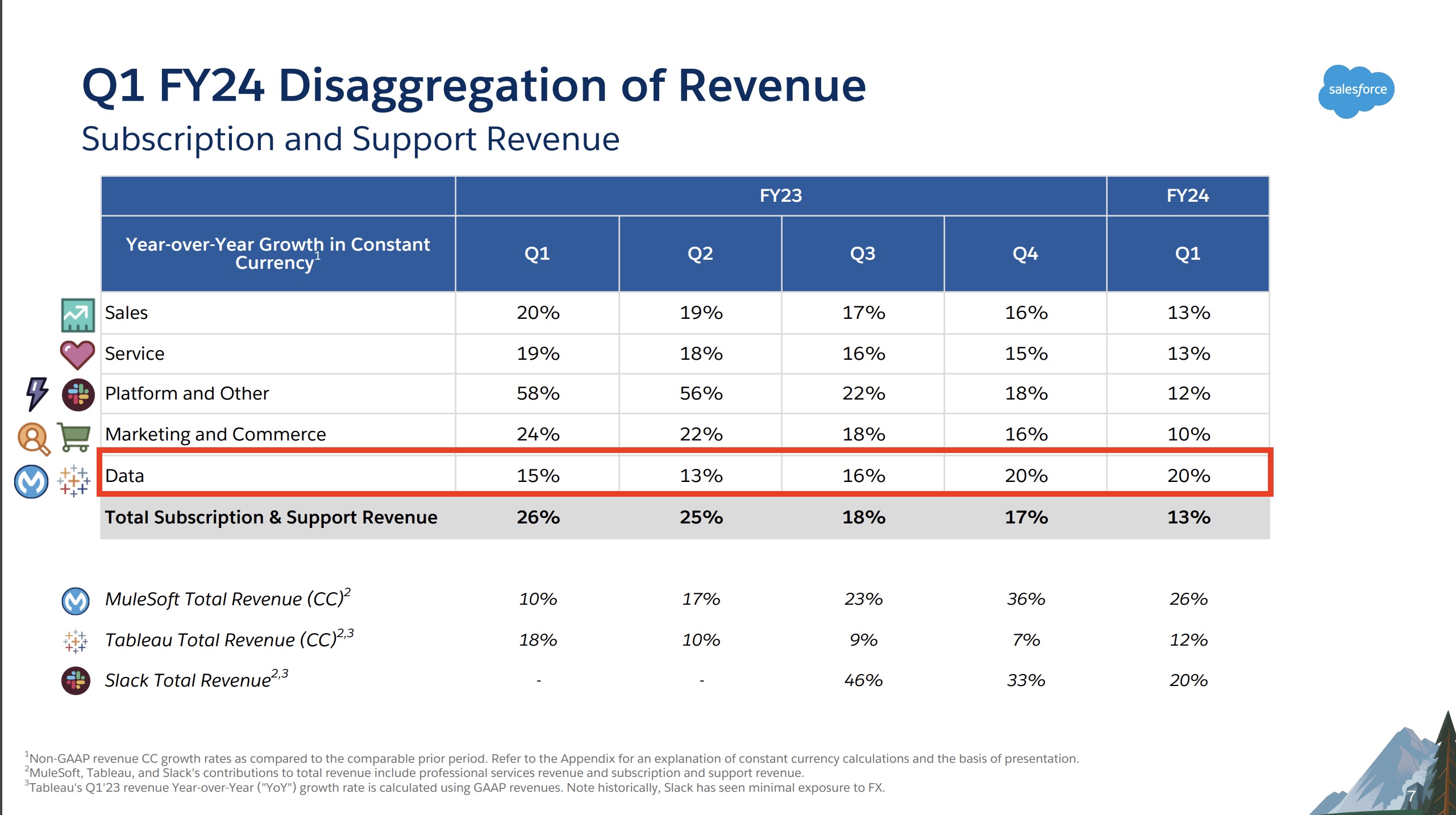
Image Credits: Salesforce
Perhaps the fact it’s new could account for some of that growth since it’s always easier to grow faster when starting with a smaller number, but it could also signal a focus shift where the data exhaust being generated by the Salesforce family of products could become more valuable than the products themselves, at least in terms of new revenue adds.
At a recent customer event in New York last month, the company’s main keynote focused almost exclusively on generative AI, and that by using Salesforce data instead of the open internet, you could reduce some of the issues around hallucinations where the model makes things up, as well as data ownership and governance problems.