London — 18th March 2026 — Global Citizen Solutions (“GCS”), a leading advisory firm in citizenship and residency planning, today published a new briefing entitled Asset Allocation for High-Net-Worth Individuals: Sovereign Risk Diversification in a Volatile Global Market, examining how portfolio strategy among high-net-worth individuals (HNWIs) is shifting beyond asset classes toward jurisdictional positioning.
North America remains home to the largest HNWI population globally, at approximately 8.45 million individuals, with the top 1% of US wealth holders controlling around 35.5% of national wealth, a concentration among the highest in advanced economies. Yet despite this domestic concentration, many of the world’s wealthiest investors are increasingly looking beyond their home jurisdictions, not only for returns, but for legal and jurisdictional resilience.
From 60/40 to Sovereign Risk
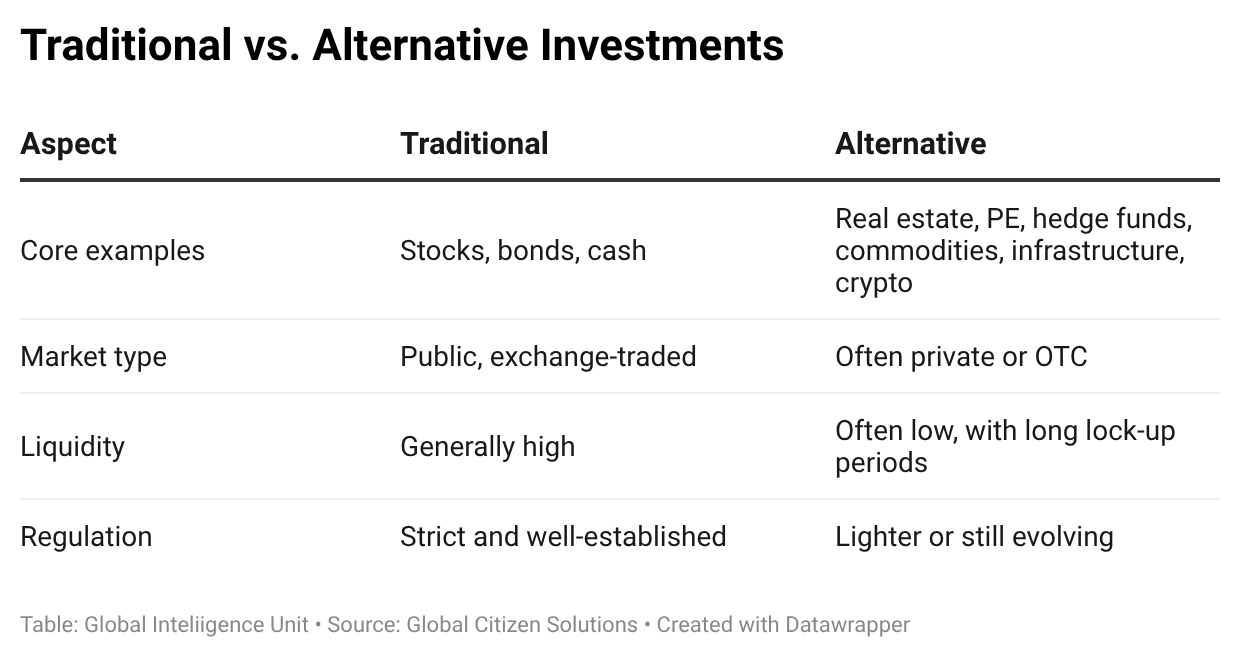
The traditional 60/40 model is under pressure according to GCS’ research arm, the Global Intelligence Unit. Low interest rates and episodes of simultaneous equity and bond declines have weakened its diversification logic. In response, alternative assets now account for approximately 42–44% of family office portfolios, with private equity alone representing around 21%.
However, the briefing finds that asset diversification alone is no longer sufficient. Geopolitical fragmentation, capital controls, and regulatory divergence are positioning sovereign environments themselves as a material source of risk. Events such as the Cyprus bail-in and Argentina’s capital controls illustrate how policy decisions can directly affect private wealth outcomes.
“Financial diversification protects against market volatility, but when sovereign systems themselves become the risk, it is no longer sufficient,” said Patricia Casaburi, CEO of Global Citizen Solutions. “Investment migration becomes a mechanism for jurisdictional diversification and long-term risk management.”
The Borderless Portfolio
The report introduces the “borderless portfolio”, a model in which capital is allocated not only across asset classes, but across multiple jurisdictions. Under this framework, legal status becomes part of portfolio construction.
Investment migration, including alternative citizenship and residency-by-investment programmes, is identified as a primary mechanism through which HNWIs formalise this flexibility. The global investment migration market is estimated at $20–30 billion annually.
“Alternative assets have reshaped family office portfolios in the last decade, however geopolitical fragmentation is redefining the framework itself, requiring diversification across both assets and jurisdictions.” said João Pacheco, Head of Institutional Partnerships at Global Citizen Solutions.
A Structural Shift in Capital
An estimated $124 trillion is expected to transfer across US households by 2048, shifting capital allocation decisions toward a younger generation of investors with markedly different risk appetites and asset preferences. Women are set to receive a significant share of this transfer – research suggests female investors tend to favour more diversified, stability-oriented portfolios, and are more likely to align financial decisions with personal values, including jurisdictional considerations. Together, these demographic shifts are accelerating demand for alternative assets, cross-border structuring, and jurisdictional diversification.
Key Data Points
- Over 23 million HNWIs globally (Capgemini, 2025)
- Alternative assets represent approximately 42–44% of family office portfolios (BlackRock, UBS, 2025)
- Cross-border portfolio investment holdings reached $71.1 trillion as of June 2024, including $40.2 trillion in equities (IMF, 2025)
- $124 trillion projected US intergenerational wealth transfer by 2048 (Cerulli, 2024)
- Global investment migration market estimated at $20–30 billion annually
